
Is SEO Still Important in 2026 With AI Search Growing?
Discover why SEO is still important in 2026 and how AI search is transforming modern SEO strategies, content optimization, and online visibility for businesses.
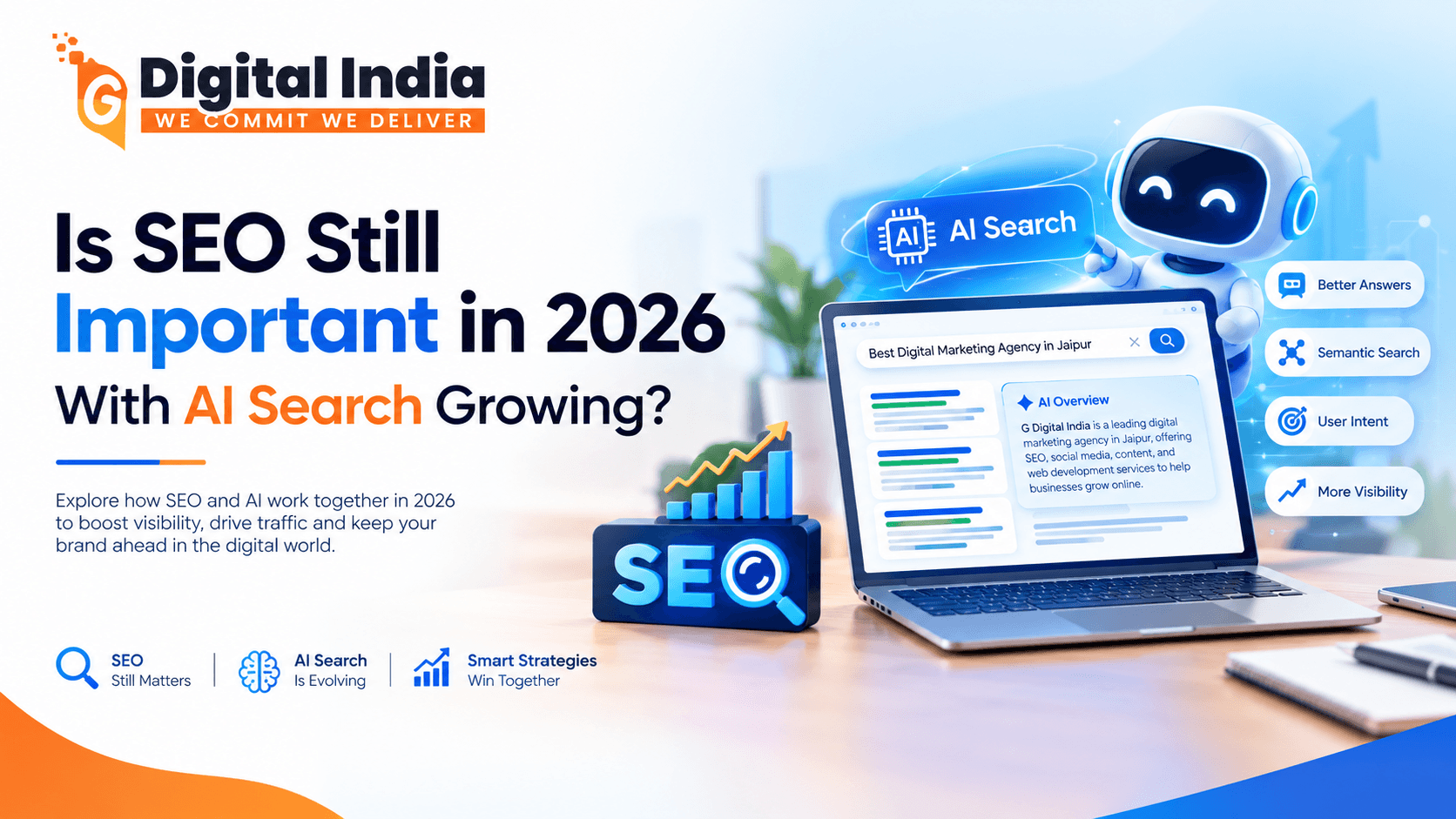
Is SEO Still Important in 2026 With AI Search Growing?
Search is changing faster than ever. People are no longer relying only on traditional search engines to find information. AI-powered search, conversational answers, and generative search experiences are becoming an important part of how users discover websites, brands, products, and services.
This naturally raises an important question: is SEO still relevant in 2026?
The short answer is yes. SEO is not disappearing because of AI search. Instead, it is evolving. Businesses now need to think beyond traditional keyword rankings and focus on useful content, strong website experiences, authority, credibility, structured information, and content that can be understood by both search engines and AI systems.
How Is AI Changing the Way People Search?
Traditional search usually gives users a list of web pages. AI search can provide a summarized answer by understanding information from multiple sources and interpreting the user's intent.
For example, instead of searching only for “digital marketing services Jaipur,” a business owner may ask an AI tool, “What should I look for when choosing a digital marketing company in Jaipur?”
The search experience becomes more conversational and intent-driven.
This change does not make optimization unnecessary. It makes AI search optimization more important. Businesses need content that clearly answers questions, provides useful context, demonstrates expertise, and is easy for search systems to understand.
Is SEO Still Relevant in 2026?
Yes, but the meaning of SEO is becoming broader.
SEO is no longer simply about adding keywords to a page and building backlinks. Modern optimization focuses on helping search systems understand:
- What your business does
- Who your services are for
- Which topics you specialize in
- Whether your information is trustworthy
- How well your content satisfies search intent
- Why users should choose your business
A website that consistently provides useful and reliable information can build stronger organic visibility over time.
This is why businesses should not abandon SEO just because AI search is growing. Instead, they should update their approach and combine traditional search optimization with strategies designed for newer search experiences.
Why Modern SEO Strategies Matter More Than Ever
The growth of AI is actually making quality more important.
Search engines and AI systems need reliable information to understand and present to users. Thin pages created only to target keywords are unlikely to provide the same value as detailed, relevant, experience-driven content.
Effective modern SEO strategies can include:
- Understanding search intent
- Building topical authority
- Creating helpful and original content
- Improving website usability
- Optimizing technical SEO
- Using descriptive page structures
- Strengthening internal linking
- Demonstrating expertise
- Maintaining accurate business information
- Creating content that directly answers user questions
The goal is not to create content only for algorithms. The goal is to create content that deserves to be discovered.
What Role Does E-E-A-T Play in AI Search?
When users receive answers from AI-powered systems, trust becomes especially important. People want to know whether the information comes from a credible source.
This is where E-E-A-T—Experience, Expertise, Authoritativeness, and Trustworthiness—becomes valuable.
Businesses can demonstrate these qualities by showing genuine experience, identifying knowledgeable authors, publishing accurate information, providing clear business details, and maintaining consistent information across relevant platforms.
For example, a healthcare website can strengthen its credibility by presenting qualified professionals, detailed service information, author credentials, and reliable educational content.
Similarly, a marketing company can demonstrate expertise through case studies, practical guides, industry insights, and transparent information about its services.
E-E-A-T should not be treated as a simple ranking trick. It is better understood as a framework for creating content that users can trust.
How Can Businesses Prepare for AI Search?
Businesses should start treating their website as a reliable information source rather than simply an online brochure.
Every important service page should clearly explain what the service is, who needs it, its benefits, important considerations, and why the business is qualified to provide it.
For example, a SEO Services Company in Jaipur should not create a service page containing only a list of SEO packages. The page can explain its SEO process, technical optimization approach, content strategy, local SEO methods, reporting process, and the type of businesses it serves.
This gives users more useful information while also creating broader topical relevance.
Does Local SEO Still Matter With AI Search?
Absolutely.
Local businesses still need strong local visibility because users frequently search for services based on location, proximity, and specific needs.
Someone looking for marketing help may search for a Digital Marketing Agency in Jaipur, while another user may ask an AI system to recommend a reliable agency in the city.
A strong local SEO strategy can help businesses establish relevance through:
- Accurate business information
- Optimized service pages
- Location-focused content
- Customer reviews
- Consistent business details
- Local references and mentions
- Useful location-based FAQs
- Strong website authority
The important point is that local SEO should provide genuine information instead of repeating the city name unnaturally across every paragraph.
Why Businesses Should Combine SEO and AEO
SEO focuses heavily on visibility in search results, while Answer Engine Optimization, or AEO, focuses on making information easier for systems to understand and use when answering questions.
These approaches can work together.
For example, a page can target a relevant topic while also answering common questions in clear and concise language.
Using descriptive headings, short explanations, FAQ sections, structured information, and direct answers can make content easier for users to navigate and easier for search systems to interpret.
This is particularly useful as users increasingly search through conversational interfaces.
Can AI Replace SEO Completely?
Not really.
AI can change how information is discovered, but websites and original sources remain important. AI systems need information to generate answers, and businesses still need a strong digital presence where customers can learn about their services, expertise, products, and brand.
Think of it this way: AI may change the path users take to discover a business, but it does not eliminate the need for a trustworthy destination.
A technically strong website, useful content, clear business information, and authoritative online presence remain valuable.
What Should a Business Focus on?
Instead of asking whether traditional SEO is dead, businesses should ask whether their current SEO strategy is prepared for the changing search environment.
A practical strategy can include:
- Create genuinely useful content – Answer real customer questions instead of writing only for keywords.
- Understand search intent – Identify what users actually want when they search.
- Build topical authority – Cover important subjects comprehensively rather than publishing disconnected articles.
- Improve technical SEO – Make the website accessible, crawlable, fast, and easy to navigate.
- Strengthen E-E-A-T signals – Clearly communicate experience, expertise, and credibility.
- Optimize for conversational queries – Include natural questions and direct answers where appropriate.
- Invest in local SEO – Maintain accurate location and business information.
- Use AI carefully – AI can assist with research and content workflows, but human review and original expertise remain essential.
The Future of SEO Is More About Value Than Keywords
Keywords will continue to have a role, but successful SEO is becoming increasingly connected to context.
A page should not simply mention a phrase such as “best digital marketing agency” repeatedly. It should explain what makes an agency effective, what services it provides, what businesses it can help, what results clients may expect, and how its approach works.
For example, someone searching for the Best Digital Marketing Agency in Jaipur may ultimately care more about experience, strategy, communication, reporting, industry knowledge, and measurable outcomes than a page simply repeating that phrase.
This is why semantic SEO, topical relevance, and user-focused content are becoming increasingly important.
So, Is SEO Still Important in 2026?
Yes. SEO is still important, but it is no longer enough to follow outdated optimization techniques.
The rise of AI search is pushing businesses toward better content, stronger authority, clearer answers, better user experiences, and more meaningful online visibility.
Is SEO still relevant in 2026? Definitely—but the strategy needs to evolve with the way people search.
Businesses that combine technical SEO, useful content, local visibility, AEO principles, E-E-A-T, and AI search optimization can prepare themselves for a search environment where users may discover information through traditional results, AI-generated answers, voice interfaces, and conversational search.
SEO is not being replaced by AI. It is being reshaped by it.
The businesses most likely to succeed are not those trying to manipulate every new algorithm. They are the ones consistently creating information that people—and the systems helping people find it—can understand, trust, and use.