
NMC Guidelines 2026 for Doctors & Hospitals: New Digital Marketing and Advertising Rules Explained
Explore the NMC Guidelines 2026 for doctors and hospitals, including new rules for healthcare digital marketing, SEO, Google Ads, patient testimonials, before-and-after photos, and ethical medical advertising in India.
Digital marketing has become an important part of how patients find doctors, compare hospitals, and learn about treatment options. From Google searches to Instagram videos, healthcare organisations now communicate with patients across several online platforms.
However, medical advertising is different from advertising an ordinary product or service. Patients may make important healthcare decisions based on what they read or watch online. An exaggerated claim, misleading treatment result, or fabricated review can influence those decisions.
On 6 October 2026, the National Medical Commission (NMC) issued its Guidelines on Ethical Advertising and Public Communication by Hospitals/Medical Institutions and Registered Medical Practitioners.
These guidelines address how doctors, hospitals and medical institutions communicate information about their services, qualifications, facilities and treatments. They also cover promotional activities carried out through websites, social media, advertising platforms and third-party agencies.
For doctors, hospital owners and healthcare marketing teams, the message is clear: digital communication must prioritise accurate medical information, patient privacy and professional ethics.
This article explains what the NMC Guidelines 2026 mean for healthcare websites, SEO, Google Ads, patient testimonials, before-and-after photographs and social media marketing.
Official reference: National Medical Commission – Ethical Advertising Guidelines, 6 October 2026 (PDF)
What Are the New NMC Guidelines 2026?
The National Medical Commission regulates medical education and professional standards for registered medical practitioners in India.
Its October 2026 guidelines establish requirements for ethical advertising and public communication by medical practitioners and healthcare institutions.
The guidelines address several practices that have become common in healthcare marketing, including:
- Exaggerated claims about doctors and treatment outcomes
- Promotional patient testimonials and success stories
- Before-and-after photographs used to attract patients
- Misleading advertisements on digital platforms
- AI-generated patient endorsements and fabricated outcomes
- Paid manipulation of online reviews and search rankings
- Advertising conducted through third-party marketing agencies
The guidelines distinguish between providing factual healthcare information and promoting medical services in ways that may mislead or improperly influence patients.
They should be read alongside the applicable professional conduct regulations, including the Indian Medical Council (Professional Conduct, Etiquette and Ethics) Regulations, 2002.
Can Doctors and Hospitals Still Do Digital Marketing?
Yes, but not every digital marketing activity or advertisement is permissible.
The NMC guidelines do not impose a blanket ban on healthcare websites, search engine optimisation or publishing educational medical information.
The important distinction is between factual communication and prohibited professional promotion.
For example, a hospital website can provide accurate information about its departments, facilities, location, visiting hours and available medical services, subject to the applicable conditions.
A doctor can also communicate verified professional details and provide educational information within the relevant ethical framework.
However, promotional content that claims a doctor is superior to others, guarantees treatment results or uses patients' experiences as endorsements can raise serious compliance concerns.
Healthcare organisations should therefore review both the information they publish and the methods they use to promote it.
Are Before-and-After Photos Allowed on Medical Websites?
Before-and-after photographs are frequently used in plastic surgery, cosmetic procedures, dermatology and aesthetic treatment marketing.
A plastic surgery website, for example, might display photographs showing a patient's appearance before and after liposuction, rhinoplasty or another procedure.
Under paragraph 8.1(v) of the October 2026 guidelines, registered medical practitioners are restricted from using promotional before-and-after photographs, case presentations, celebrity patients and success stories.
A narrow exception exists for genuine scientific or educational purposes, subject to anonymisation and appropriate consent.
Does patient consent make promotional before-and-after photos acceptable?
Not automatically.
Even when a patient provides written permission to publish photographs, that consent does not override professional advertising restrictions.
For this reason, doctors and healthcare marketing teams should not assume that a signed consent form is sufficient to publish a promotional before-and-after gallery.
What should plastic surgery websites publish instead?
Plastic surgery websites can focus on educational information such as:
- Who may be suitable for a particular procedure
- How the procedure is performed
- Possible risks and complications
- Recovery and aftercare
- Limitations of the procedure
- Verified surgeon qualifications
- Hospital facilities and consultation information
Medical illustrations and non-identifiable educational visuals may also help explain procedures, provided they are accurate and not misleading.
This approach allows patients to understand a treatment without relying on selective photographs of individual outcomes.
Can Doctors Publish Patient Testimonials and Video Reviews?
Patient testimonials have been widely used across healthcare websites, YouTube channels, Instagram pages and Google advertising campaigns.
Common examples include a patient describing a successful operation, a maternity patient thanking a gynecologist, or a video claiming that a particular doctor provides the best treatment.
The NMC guidelines place significant restrictions on using patient testimonials, recommendations, endorsements and reviews for professional promotion.
Doctors should not request or share patient testimonials on social media to promote their practice.
Promotional testimonial videos and patient success stories on websites should also be reviewed against the restrictions on advertising and patient solicitation.
What about genuine Google reviews?
There is an important distinction between an independent patient review appearing on a third-party platform and a doctor actively requesting, manipulating or republishing reviews for promotional purposes.
Fake reviews, paid endorsements, incentivised ratings and manufactured patient experiences should not be used.
Healthcare organisations should also avoid automatically copying Google reviews into promotional website sliders without reviewing the applicable ethical restrictions.
A review being genuine does not necessarily make every promotional use of that review permissible.
NMC Guidelines 2026 for Google Ads and Meta Ads
Google Ads, Facebook and Instagram are widely used by hospitals and clinics to communicate with prospective patients.
However, paid advertisements are subject to the same professional advertising principles as other promotional communications.
Doctors and healthcare institutions must consider the content of an advertisement, who is publishing it, its intended purpose and whether it encourages prohibited patient solicitation.
Advertising claims that require particular caution
Examples include:
- "India's No. 1 Plastic Surgeon"
- "100% Successful IVF Treatment"
- "Guaranteed Hair Transplant Results"
- "Best Gynecologist with Guaranteed Normal Delivery"
- "Completely Risk-Free Surgery"
- "Limited-Time Discount on Medical Procedures"
These statements may involve unsupported superiority claims, misleading guarantees or promotional inducements.
Simply changing the advertisement platform does not make prohibited content acceptable.
Can hospitals advertise their facilities?
The guidelines provide a framework for hospitals and medical institutions to communicate factual institutional information.
Information about recognised facilities, departments, services, location and infrastructure should be accurate, verifiable and presented without exaggerated claims.
Hospital-led advertising and individual doctor self-promotion are not identical under the guidelines. Each campaign needs to be reviewed according to the applicable provisions.
Is SEO Allowed Under the NMC Guidelines 2026?
Search engine optimisation (SEO) helps websites become easier for search engines to discover, understand and display in relevant search results.
The NMC guidelines do not prohibit ordinary technical SEO or the publication of factual, educational medical information.
However, SEO cannot be used as a justification for publishing misleading advertisements or manipulating rankings.
Healthcare SEO practices that remain useful
1. Educational medical content
A gynecology website can explain pregnancy care, menstrual health, PCOS, menopause and when patients should seek medical advice.
2. Verified doctor profiles
Doctor pages can include recognised qualifications, registration information, professional experience and relevant clinical areas.
3. Technical SEO
Improving website speed, mobile usability, accessibility, crawlability, canonical tags and site architecture does not inherently involve misleading medical advertising.
4. Local business information
Hospitals can maintain accurate contact details, location information and opening hours, while following applicable professional and platform rules.
5. Clear treatment information
Patients should be able to understand what a procedure involves, its limitations, potential risks and available alternatives.
For organisations reviewing their online presence, G Digital India provides healthcare digital marketing services for doctors and hospitals, including website development, SEO and digital communication support.
All healthcare marketing activities should be evaluated against the applicable professional advertising requirements.
Can You Still Target Keywords Like "Best Doctor in Jaipur"?
Search behaviour and advertising claims are two different things.
A patient may search Google for "best plastic surgeon in Jaipur" or "best gynecologist near me". These search queries reflect how people look for medical services.
However, a doctor declaring themselves the "best", "No. 1" or "most successful" without an appropriate basis raises professional advertising concerns.
Healthcare SEO should not depend on repeating unsupported superiority claims throughout website headings, meta descriptions and page content.
Instead, a page can provide information that helps patients assess a doctor's suitability.
For example, an orthodontic, gynecology or plastic surgery page can explain the doctor's qualifications, clinical services, consultation process and relevant patient considerations.
The aim should be to answer the user's search query without making misleading claims.
What Do the NMC Guidelines Say About AI-Generated Healthcare Content?
Artificial intelligence is increasingly used to create social media posts, videos, images, website content and advertisements.
The NMC's October 2026 guidelines specifically address AI-generated promotional material.
They prohibit misleading AI-generated patient experiences, fabricated testimonials, synthetic endorsements and false treatment outcomes. The guidelines also restrict AI-generated promotional campaigns for commercial interests and require appropriate identification of permitted AI-generated content.
Examples of high-risk AI content
A clinic should not publish a synthetic patient video claiming that a doctor successfully treated a medical condition.
Similarly, an AI-generated photograph should not be presented as a genuine patient's treatment result.
Healthcare organisations should establish an editorial review process for AI-assisted content, including checks for medical accuracy, authenticity, attribution and compliance.
AI may assist with internal research or drafting, but its use does not remove the responsibility to ensure published material meets professional requirements.
What Do the Guidelines Mean for Gynecologists?
Gynecology and maternity websites frequently include patient experiences, delivery photographs, pregnancy success stories and testimonial videos.
These formats deserve particular attention because they may involve sensitive patient information and promotional claims about clinical outcomes.
A gynecology website should prioritise:
- Antenatal and postnatal care information
- Menstrual and reproductive health education
- Information about high-risk pregnancies
- Available hospital facilities
- Verified gynecologist qualifications
- Explanations of procedures and possible complications
- Clear contact and consultation information
Patient photographs, identifiable delivery stories and testimonial videos should not be used as promotional material without assessing the restrictions in the NMC guidelines.
Even with patient consent, professional advertising limitations remain relevant.
What Do the Guidelines Mean for Plastic Surgeons?
Plastic surgery marketing often relies on visual results.
Before-and-after sliders, transformation videos and patient success stories can create unrealistic expectations, particularly when they display only selected outcomes.
Under the new guidelines, plastic surgery websites should avoid using these materials for promotional purposes.
A more appropriate content strategy focuses on helping patients understand procedures such as liposuction, rhinoplasty, reconstructive surgery and scar revision.
Pages should discuss who may be eligible, how procedures work, what recovery involves and what risks patients should understand before making a decision.
Doctors should also avoid suggesting that every patient can expect the same outcome.
What About Dental Clinics and Dentists?
Dental professionals are subject to a distinct professional regulatory framework, including the Revised Dentists (Code of Ethics) Regulations, 2014.
Therefore, the NMC guidelines should not automatically be treated as identical rules for every independently practising dentist.
Dental clinics should review their marketing under the applicable DCI regulations, relevant healthcare advertising laws and any NMC requirements that may apply to the institution or practitioners involved.
Dental marketing should also avoid misleading treatment guarantees, fabricated reviews and unsupported claims of professional superiority.
Reference: Dental Council of India – Official Website
What Should Healthcare Digital Marketing Agencies Change?
The new guidelines are relevant not only to doctors and hospitals but also to agencies that create or manage healthcare advertising.
A digital marketing agency cannot assume that prohibited content becomes acceptable simply because it is published through a third party.
Agencies should review their content approval procedures, advertising campaigns, testimonial practices and contractual arrangements.
Particular care is required where payments or incentives are connected to patient procurement, referrals or other prohibited solicitation practices.
A responsible healthcare marketing workflow should include the following steps.
1. Audit existing healthcare websites
Review homepage claims, treatment pages, doctor profiles, testimonial sections, before-and-after galleries and promotional banners.
2. Review social media content
Check Instagram Reels, Facebook posts, YouTube videos, patient endorsements, influencer collaborations and paid promotions.
3. Reassess advertising campaigns
Review ad copy, landing pages, guarantees, offers and calls to action under the applicable rules for the practitioner or institution.
4. Verify medical information
Confirm qualifications, registration details, clinical statistics and treatment claims with authorised medical personnel.
5. Establish a content approval process
Healthcare content should be reviewed for factual accuracy, patient privacy and professional advertising compliance before publication.
6. Review agency agreements
Advertising agencies and healthcare organisations should clearly define permitted activities, approval responsibilities and restrictions on patient solicitation or referral-linked compensation.
NMC Guidelines 2026: Healthcare Website Compliance Checklist
Before publishing or updating a healthcare website, doctors, hospitals and digital marketing teams should review the following areas to ensure their content follows applicable professional advertising and ethical standards.
1. Doctor Qualifications and Registration Details
Ensure that all medical qualifications, specialisations, professional experience and registration details are accurate and verifiable. Display registration information wherever required under applicable regulations.
2. Treatment and Service Information
Keep treatment descriptions factual, clear and balanced. Explain procedures, possible risks, recovery and limitations without making exaggerated promises or guaranteeing results.
3. Before-and-After Photographs
Avoid using patient before-and-after photographs for promotional purposes. Any genuine scientific or educational use should be assessed separately for consent, anonymisation and compliance with applicable guidelines.
4. Patient Testimonials and Video Reviews
Avoid using patient testimonials, success stories and treatment-result videos as promotional material where restricted by professional advertising rules. Patient consent alone does not automatically make promotional use permissible.
5. Treatment Success Rates and Guarantees
Remove unsupported claims such as "100% Success Rate", "Guaranteed Results" or "Risk-Free Surgery". Any clinical statistics published should be accurate, verifiable and presented with appropriate context.
6. Google Ads and Social Media Advertising
Review Google Ads, Facebook Ads, Instagram campaigns and promotional landing pages. Ensure advertisements comply with the applicable rules for doctors and medical institutions, particularly regarding patient solicitation and misleading claims.
7. AI-Generated Healthcare Content
Review AI-generated images, videos, testimonials and medical content before publication. Do not present fictional patients, fabricated treatment outcomes or synthetic endorsements as genuine. Follow applicable disclosure and advertising requirements.
8. Google Reviews and Online Reputation
Avoid fake reviews, paid ratings, incentives for positive feedback and manipulation of online rankings. Review whether displaying patient reviews on promotional website sections is permitted under the relevant professional regulations.
9. Hospital and Clinic Photographs
Use genuine photographs of hospital infrastructure, consultation rooms, medical equipment and available facilities wherever possible. Ensure images accurately represent the institution and do not disclose identifiable patient information without appropriate authorisation.
10. Medical Blogs and Educational Content
Publish medically accurate, evidence-based information that helps patients understand health conditions and treatments. Arrange appropriate medical review and update articles when relevant clinical guidance changes.
11. Digital Marketing Agency Agreements
Review agreements between healthcare organisations and marketing agencies. Ensure services, payment arrangements and promotional activities do not involve prohibited patient solicitation, referral commissions or misleading advertising practices.
Important Note: This checklist provides general guidance for healthcare website reviews. Doctors, hospitals and marketing agencies should refer to the official NMC guidelines and other applicable professional regulations before making compliance decisions.
Final Thoughts
The NMC Guidelines 2026 represent an important development in how doctors, hospitals and medical institutions communicate with patients.
For healthcare organisations, the priority should not simply be removing a few promotional phrases. It should be reviewing the overall way medical services, professional credentials, patient experiences and treatment outcomes are presented online.
Accurate information, transparent communication and respect for patient privacy can help people make more informed healthcare decisions.
At G Digital India, we work with healthcare organisations on website development, SEO and digital communication. Our approach is to build useful online experiences while recognising the ethical responsibilities involved in healthcare marketing.
If your hospital or clinic is reviewing its digital presence following the new NMC guidelines, explore our healthcare digital marketing services.
Frequently Asked Questions
1. When were the new NMC advertising guidelines issued?
The National Medical Commission issued its guidelines on ethical advertising and public communication on 6 October 2026.
2. Are doctors allowed to have websites under the new guidelines?
Yes. The guidelines do not impose a blanket ban on doctor websites. However, their content and promotional use must comply with the applicable professional advertising requirements.
3. Can plastic surgeons publish before-and-after photographs?
Promotional before-and-after photographs are restricted. A narrow exception exists for genuine scientific or educational use with appropriate anonymisation and consent.
4. Can doctors publish patient testimonial videos?
Using patient testimonials and success stories for professional promotion is restricted. A patient's consent alone does not override these advertising restrictions.
5. Is SEO banned for doctors and hospitals?
No. Ordinary technical SEO and factual educational content are not banned. However, misleading claims, prohibited promotional practices and paid manipulation of rankings are not acceptable.
6. Can hospitals run Google Ads?
Hospitals may communicate factual institutional information within the applicable guidelines. Whether a particular paid advertisement is permissible depends on its content, purpose and the relevant provisions.
7. Can doctors use AI-generated images and videos?
AI-generated promotional content is subject to significant restrictions. Fabricated patients, testimonials, endorsements and treatment outcomes must not be presented as genuine.
8. Do the NMC guidelines apply to dentists?
Dentists have a separate professional ethics framework under DCI regulations. The applicable requirements depend on the practitioner and institutional context.
9. Can a healthcare marketing agency manage a doctor's website?
Yes, subject to the applicable professional rules. Agencies must ensure that their work does not involve prohibited advertisements, misleading content or improper patient solicitation.
Official References
- National Medical Commission – Guidelines on Ethical Advertising and Public Communication, 6 October 2026
- National Medical Commission – Official Website
- Indian Medical Council (Professional Conduct, Etiquette and Ethics) Regulations, 2002 – NMC Regulations Portal
- Dental Council of India – Official Website
Disclaimer: This article provides general information about healthcare advertising and digital marketing requirements in India. It is not legal advice. Doctors, hospitals and marketing agencies should review the official guidelines and obtain appropriate professional compliance advice before implementing advertising campaigns.
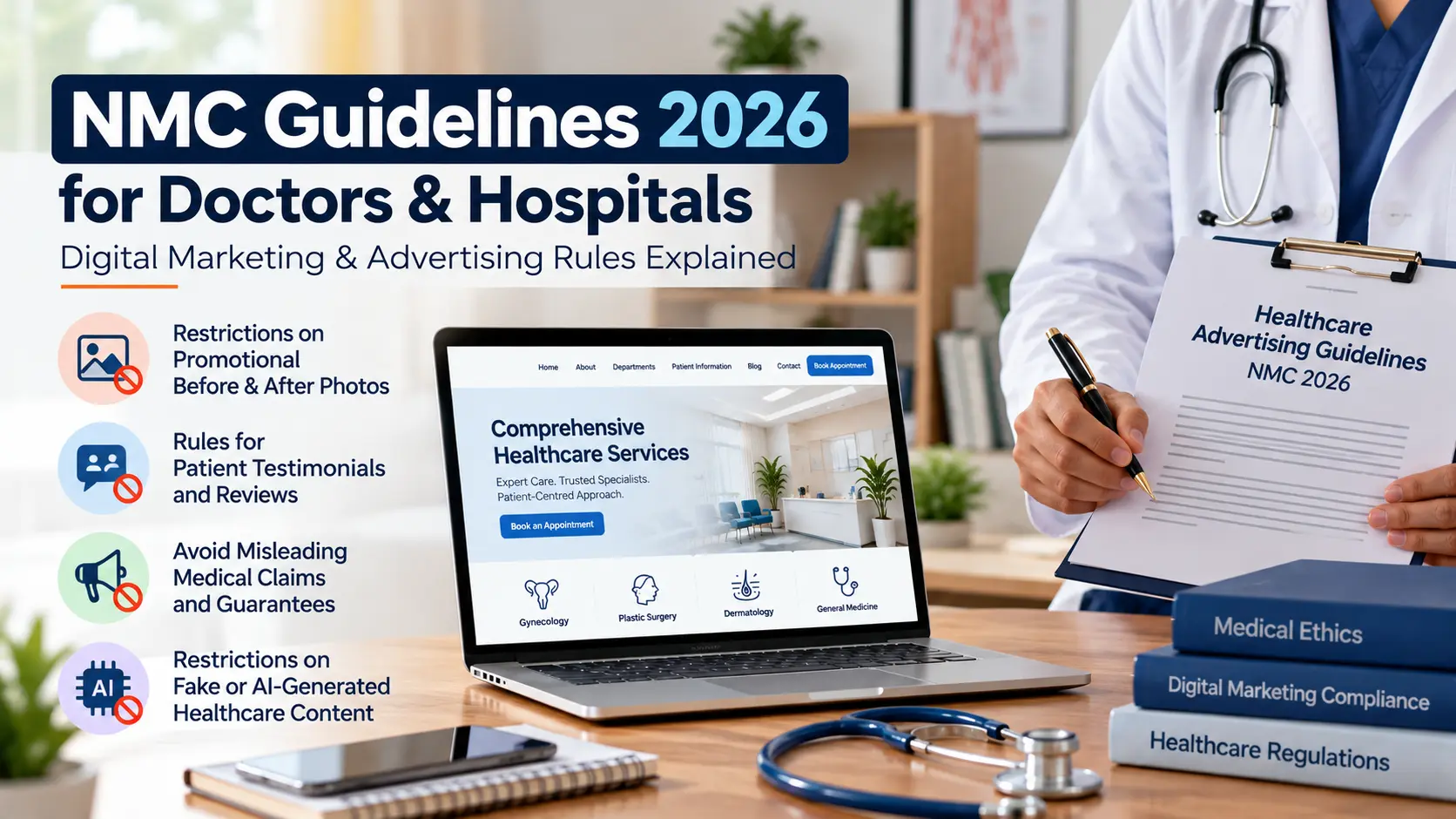
Image Disclaimer: This is an AI-generated illustration created for educational and informational purposes only. It does not represent a real doctor or an official publication of the National Medical Commission (NMC).