
Google Algorithm Updates 2026: Complete SEO Guide
Stay updated with Google Algorithm Updates 2026. Learn about the latest SEO changes, AI search, E-E-A-T, ranking factors, and strategies to improve your website’s search visibility.
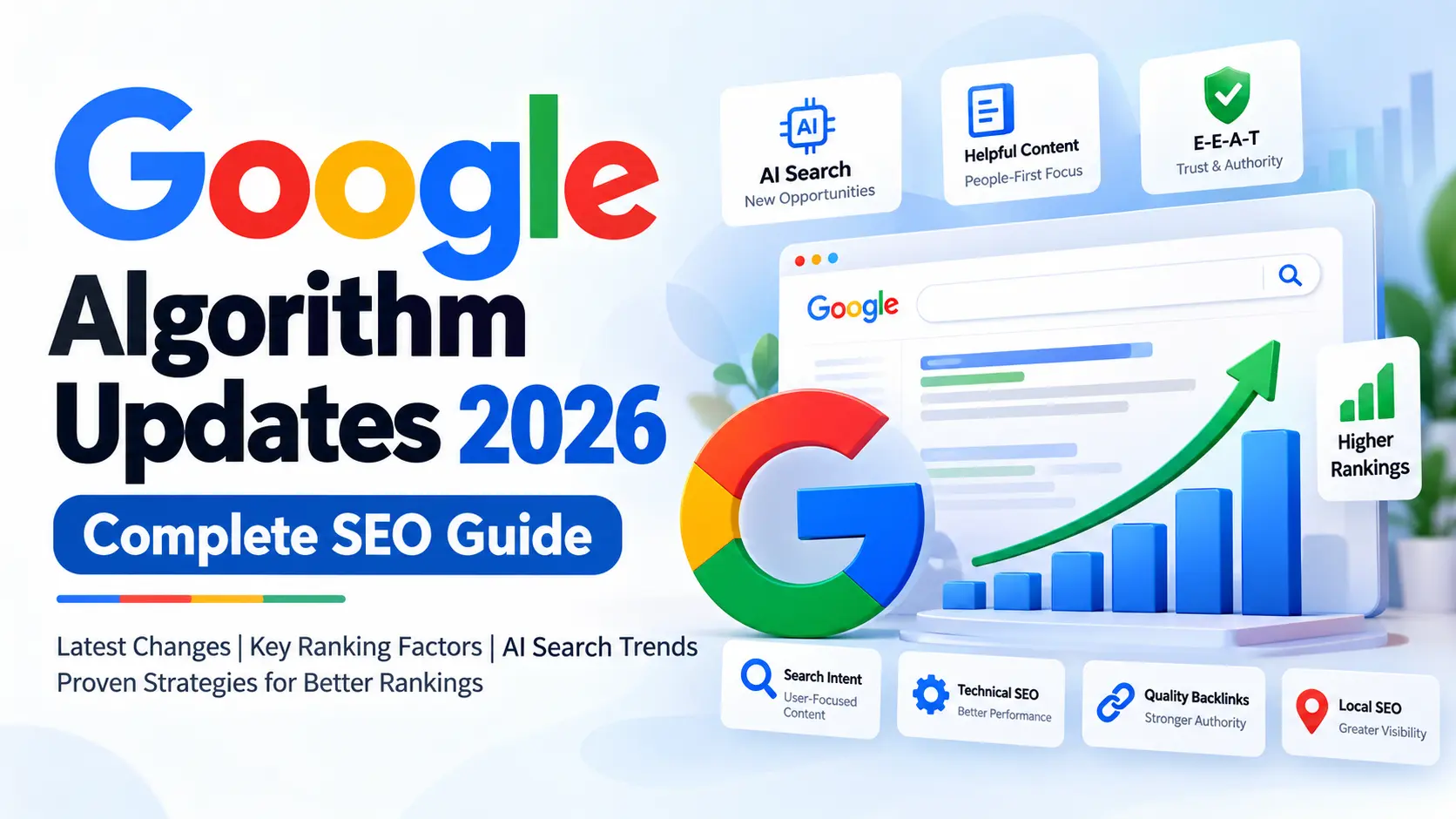
Google continuously refines its search algorithms to deliver the most relevant, helpful, and trustworthy results to users. As we move through 2026, SEO is no longer just about keywords and backlinks. Google's ranking systems now focus heavily on user experience, content quality, expertise, AI-generated content evaluation, and search intent satisfaction.
For website owners, digital marketers, content creators, and SEO professionals, understanding the latest Google algorithm updates is essential to maintain and improve search visibility.
This complete guide explains the major Google SEO updates of 2026, their impact on rankings, and practical strategies to keep your website aligned with Google's best practices.
What Are Google Algorithm Updates?
Google's algorithm is a complex system that evaluates billions of web pages to determine which results should appear for a search query.
Google releases:
- Core Updates
- Spam Updates
- Helpful Content Improvements
- Search Quality Enhancements
- AI Search Updates
- Product Review Updates
- Local Search Improvements
Some updates are announced publicly, while others are rolled out silently throughout the year.
The primary goal remains the same:
Deliver helpful, reliable, people-first content that satisfies user intent.
Major Google SEO Trends in 2026
1. AI-Powered Search Continues to Expand
Google's AI-driven search experiences have become more sophisticated.
Search results increasingly feature:
- AI-generated overviews
- Contextual answers
- Conversational search responses
- Multi-step query understanding
- Visual and voice search integrations
This means websites must create content that directly answers user questions rather than simply targeting keywords.
What This Means for SEO
Focus on:
- Clear answers
- Structured content
- FAQ sections
- Topic clusters
- Semantic relevance
Content that demonstrates expertise and provides comprehensive answers is more likely to be referenced in AI-generated search experiences.
2. Helpful Content Signals Become Stronger
Google continues rewarding content created for people rather than search engines.
Pages designed solely to manipulate rankings often struggle after algorithm updates.
Characteristics of Helpful Content
- Original insights
- First-hand experience
- Expert opinions
- Accurate information
- Clear structure
- Strong readability
- Genuine value for users
Characteristics of Low-Quality Content
- Thin content
- Keyword stuffing
- Excessive AI-generated text without editing
- Duplicate information
- Misleading titles
- Clickbait headlines
Google increasingly evaluates whether content genuinely helps users accomplish their goals.
3. E-E-A-T Remains a Major Ranking Factor
Google continues emphasizing:
Experience
Has the author actually used, tested, or experienced the topic?
Expertise
Does the content demonstrate deep knowledge?
Authoritativeness
Is the website recognized as a trusted source?
Trustworthiness
Can users rely on the information provided?
For industries like healthcare, finance, legal services, and education, E-E-A-T plays an even greater role.
How to Improve E-E-A-T
- Create detailed author profiles
- Display credentials
- Cite reliable sources
- Publish original research
- Showcase customer reviews
- Maintain transparent business information
4. User Experience Signals Gain More Importance
Google increasingly measures how users interact with websites.
Strong user experience contributes to better engagement and stronger search performance.
Important UX Factors
Page Speed
Users expect fast-loading pages.
Mobile Friendliness
Mobile-first indexing remains critical.
Easy Navigation
Visitors should quickly find relevant information.
Visual Stability
Avoid unexpected layout shifts.
Accessibility
Content should be usable by all visitors.
Best Practices
- Compress images
- Use modern web technologies
- Improve server response times
- Optimize mobile layouts
- Simplify navigation
5. Search Intent Optimization Becomes Essential
Google has become extremely effective at understanding user intent.
A page that matches intent often outranks a page with higher keyword density.
Types of Search Intent
Informational
Example:
"What is technical SEO?"
Navigational
Example:
"Google Search Console login"
Commercial
Example:
"Best SEO tools for agencies"
Transactional
Example:
"Buy SEO audit services"
Optimization Strategy
Before creating content, identify:
- What users want
- Why they are searching
- What action they expect to take
Then structure content around those needs.
6. Semantic SEO Gains More Weight
Google increasingly understands topics rather than individual keywords.
Traditional SEO
Focus:
One keyword per page
Semantic SEO
Focus:
Entire topic ecosystem
For example, a page about SEO should naturally include related concepts such as:
- Search engines
- Rankings
- Crawling
- Indexing
- Backlinks
- User experience
- Search intent
- Technical SEO
- Content marketing
This creates stronger topical relevance.
Semantic SEO Best Practices
- Cover topics comprehensively
- Use related entities
- Include FAQs
- Build content clusters
- Create internal linking structures
7. Quality Backlinks Still Matter
Backlinks remain an important ranking factor.
However, Google's systems have become more effective at identifying manipulative link-building practices.
Valuable Backlinks
- Industry publications
- News websites
- Educational domains
- Relevant niche websites
- Authoritative blogs
Risky Backlinks
- Link farms
- Paid link schemes
- Spam directories
- Private blog networks
Quality consistently outweighs quantity.
8. Local SEO Updates Continue to Evolve
Local businesses must focus on:
- Google Business Profile optimization
- Accurate business information
- Customer reviews
- Local citations
- Location-based content
Local Ranking Factors
- Relevance
- Distance
- Prominence
Businesses that actively manage their online presence often achieve stronger visibility in local search results.
Common SEO Mistakes After Recent Google Updates
Many websites lose rankings because they continue using outdated SEO tactics.
Avoid These Mistakes
- Keyword stuffing
- Publishing low-value AI content
- Buying backlinks
- Duplicate pages
- Poor mobile experience
- Slow website speed
- Thin service pages
- Ignoring search intent
- Over-optimizing anchor text
- Publishing content without expertise
Future of SEO Beyond 2026
The future of SEO will revolve around:
AI Search Optimization
Creating content that can be understood and referenced by AI systems.
Answer Engine Optimization (AEO)
Providing direct answers to user questions.
Generative Engine Optimization (GEO)
Optimizing content for AI-powered search experiences.
Topical Authority
Building comprehensive expertise around specific subjects.
User Experience Excellence
Creating websites that genuinely satisfy visitors.
The websites that combine high-quality content, expertise, trust, and excellent user experience will continue to succeed regardless of future algorithm changes.
Action Plan for Website Owners
To stay aligned with Google's evolving algorithms:
- Create people-first content.
- Focus on search intent.
- Build topical authority.
- Strengthen E-E-A-T signals.
- Improve website speed.
- Optimize for mobile users.
- Earn quality backlinks.
- Update outdated content regularly.
- Implement structured data.
- Monitor performance through Search Console and analytics.
Conclusion
Google's algorithm updates in 2026 reinforce a clear message: SEO is no longer about gaming search engines. Success comes from creating valuable content, demonstrating expertise, and delivering exceptional user experiences.
Websites that prioritize helpful information, semantic relevance, E-E-A-T principles, and user satisfaction are far more likely to achieve sustainable rankings. Rather than chasing every algorithm change, focus on building a trustworthy, authoritative resource that genuinely serves your audience.
By aligning your SEO strategy with Google's long-term vision, you can maintain visibility, increase organic traffic, and stay competitive in an increasingly AI-driven search landscape.